Yodobashi Censorship

OK, now I am angry. Yodobashi Camera in Yokohama censored one frame from my Tri-X negative, and destroyed part of the preceding and following frames in the process, as you can see in the picture. It was mild nudity at best and I’m sure there was no genitalia in the picture, even if there was it must have not been clearly visible.

I was not notified about this when I paid and received the negatives and there was no sign in the packaging whatsoever that censorship would have taken place.

This is simply just unacceptable because the following and preceding non-nude frames were also affected by whatever dark magic they used to destroy the picture after it was developed. Also they should have explained this reason to me clearly which they never did. That is just wrong.

OK, you might think that this is a result of accidental opening of the camera while film was in since it looks like severe overexposure. But I am sure I didn’t open the camera while the film was in half way, and even if I would have accidentally done so, the film counter would have reseted. Thus I am sure I didn’t open the camera.  I have shot about a hundred rolls with my  Bessa R3M and this kind of issue has never happened. It just cannot be because of camera malfunction.

If this was an accident of the lab, that means they need to refund me since I paid for a product that wasn’t what it was promised. If this was non-accident but intentional censorship, then they should have notified me; and still that doesn’t justify destroying preceding and following frames.

So I think I’m at least entitled for a refund for damaged film.

And the question is what if I would have been shooting something important? Well this WAS important, but gladly I’m not going to lose my head over this. The lesson learned; develop yourself if it’s black and white. As noted by a fellow photographer, there’s also the risk that someone working in the lab might copy the image if it’s special enough; you just can’t be sure.

Sadly it’s just currently impossible for me to start developing color film, so I will still be dropping my Ektar100’s to Yodobashi.

Silverfast 8 in Windows 7

I am noticing huge difference in image quality when using Silverfast under Windows 7 versus Mac. When viewed at 100% I no longer see  strange jaggies which I saw in Mac version, and the images look actually sharper.

The scan speed is also much faster. Here are some numbers I was able to come up with.

Windows 64bit Silverfast 8.0.1r18  (Plustek Opticfilm 8200i)

  • 7200dpi (with iSRD) 9min 23sec
  • 3600dpi (with iSRD) 3min 13sec

Those make huge difference to the scanning speed with current mac version. I would estimate that Windows version is at least twice as fast. Moreover, the mac version sometimes scans faster and sometimes slower, and iSRD doesn’t work or works on random basis.

I would classify the current mac version unusable. If you are on mac, I recommend using Windows 7 version of Silverfast via bootcamp or Parallels, etc.

Why I love Ektar 100

Ektar 100 is a ultra-fine grain color negative film, which is designed for outdoor and studio shots. According to wikipedia it is rated as semi-professional film (although in the box it says Kodak Professional). The old Ektar was discontinued in 1994; Ektar 100 is relatively new film, based in new technology.

The results I get with Ektar 100 are amazing. There’s tons of dynamic range in the photos while the photos are rich in contrast. Colors are vivid and very natural. Even with my EOS 5D Mark II I find it difficult to achieve result that would be similarly natural or pleasing.

The film seems to respond especially well to the outdoor light and the results are immediately usable. There’s something a bit extra there what could be the magic of the film. I find that attractive and kind of “honest” to the scene I am shooting. I suppose it has something to do with white balance, digital cameras do auto white balance (if you set them to do it) while with film you kind of get what you see or whatever the film is balanced to. Ektar is really close to the dream I have always had about the perfect photo in means of the color and mood. It’s easy to fall in love with this film.

This is ISO 100 film so in rainy days it might be quite difficult to get the proper exposure unless you bring a tripod. Ektar 100 is also used for studio shooting and product shots and in Kodak’s site they actually recommend this film for those uses, likely because the photos with last some serious enlarging.

Indeed it seems that Ektar 100 shots can be enlarged very nicely, as long the scans are made properly and are a good quality. To get the scans correctly inverted requires a profile from your scanning software for this emulsion. Without the profile Ektar 100 can be tricky to scan. SilverFast Negafix plugin does feature it which is the reason why I decided to get Plustek scanner which is developed together with SilverFast (of course SilverFast comes included).

Shooting film in general is very different from shooting digital and getting to know different film stocks is necessary in order to know in advance what to get. Ektar 100 delivers for me and it is quickly becoming one of my main tools.

flower boxes

254252_10151499796419614_548684529_n

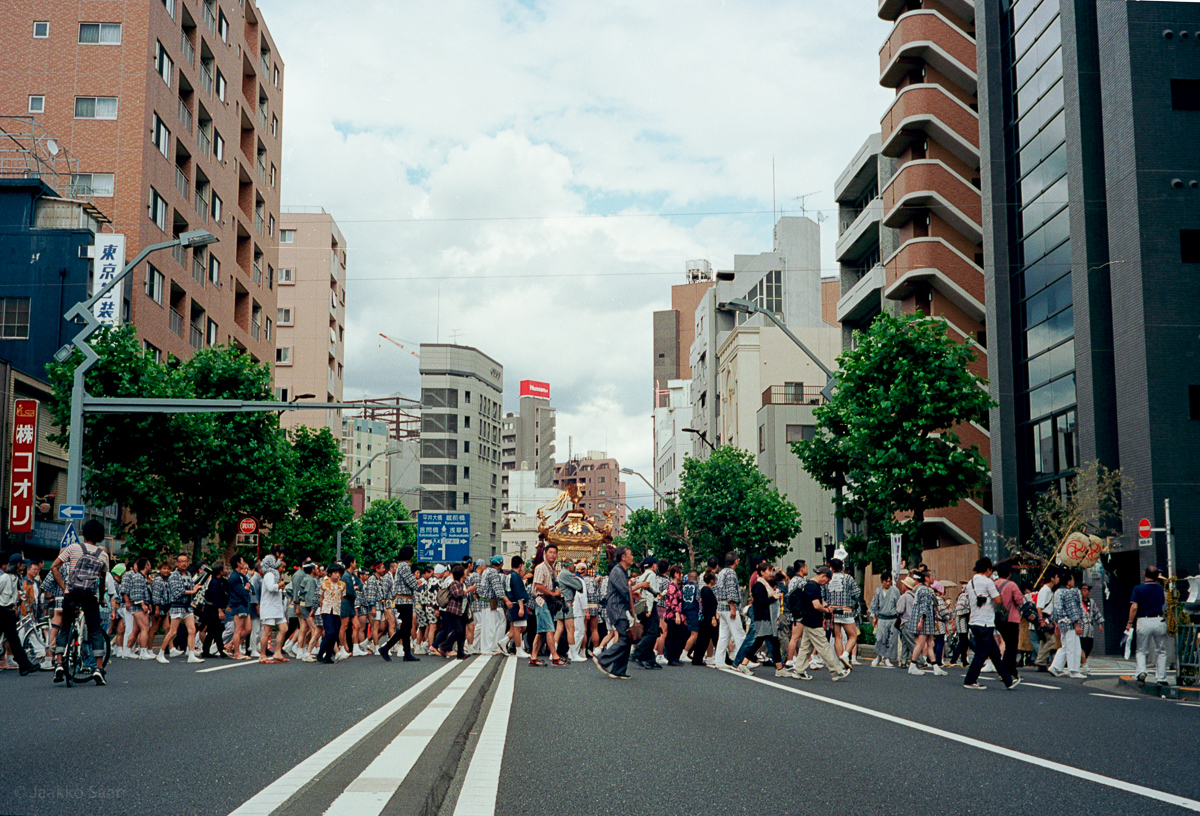
Matsuri

Looking at Leica M6

My ex girlfriend used to carry her M6 with her at all times but she rarely let me touch it. I merely envied her from a distance while she shot beautiful shots with her rangefinder camera. She always talked about “spirit of a photography” and she never carried a digital camera with her, unless she was shooting for a job. I suppose it wouldn’t be too much to say that like for Cartier-Bresson, her Leica was extension of her eye.

My friend borrowed me recently his Leica M6 TTL with 50mm Summilux ASPH.

I am moved, and amazed by this classic, legendary camera.

50mm Summilux ASPH lens has a focusing tab which allows quick focusing with index finger. It feels just right and for me the tab makes huge difference. Only in few days, I learned to approximate distances and adjust the focus roughly, only requiring a fine adjustment when lifting the camera to my eye. Same goes with metering. When shooting with a camera like this, you learn quickly to read light.

Although this camera has metering, the camera works perfectly without any electricity. I assume that pros who use Leica might not even use the metering since the red arrows in viewfinder might only be a distraction.

The viewfinder of M6 is best thing I’ve ever seen and beats my 5D Mark II and Fujifilm X100 viewfinder in clarity and sharpness. Rangefinder focusing is a pleasure, especially after you learn not to block the rangefinder window with your finger while holding the camera..

M6 is also the most solid camera I’ve ever handled. Although this means also that the camera is probably the heaviest compact camera of it’s size, the solid construction has it’s benefits. This is a camera you can take into a war. Brass (or zinc) is really strong material, and the camera is perfectly balanced. It’s very easy to hold this camera steady when shooting and this will result in sharper photos.

You have to hold one in your hand to understand. This camera is built to last a lifetime.

The mechanics of the camera feel assuringly strong as well. Pressing the shutter results a satisfying click, which is not too loud or disturbing. Although my friend’s camera came with a motor winder which is very silent and fast, I realized I rather prefer manually advancing the film by using the lever.

Although loading film is a bit of a nuisance, I find something honest and precise about loading Leica M6. It’s simply built to be as fool-proof as possible.

Since this is a full frame camera (35mm film), 50mm lens gives you plenty of coverage but also plenty of bokeh.

I think 50mm ASPH is probably the lens I would buy for Leica. The lens is razor sharp and I was unable to detect any kinds of artifacts in the image. Even the widest F1.4 aperture is tack sharp. I can’t imagine any kind of lens of this size (being F1.4!) being that sharp wide open. The nine blade aperture gives creamy, soft bokeh. Also the transition between focus and out-of-focus areas is beautiful and natural.

Overall, there is something very natural about the image quality of Leica.

Since the price of M6 came down recently, this camera seems very attractive option for many photographers. Sure, dealing with film is troublesome and also expensive if you shoot a lot.

But if you are serious about photography, I really recommend at least trying out photography with a rangefinder camera. There is something beautiful and artistic about the process of setting everything manually, and it’s possible to find entirely new aspects of photography when shooting with a classic camera such as this.

Unlike when shooting with SLR, nothing will obstruct your vision when you press the shutter. It’s possible to feel much more connected to the scene you’re shooting.

If Cartier-Bresson would be still with us, I would imagine he’d still carry his Leica with him. In today’s world of digital cameras it’s refreshing and delightful to shoot with a camera designed so meticulously to fulfill a single purpose.

Leica M6 is not a calculator. It’s a camera.

First shots with Leica M6

I went to Dark Room Intl. in Yokohama yesterday to develop the Kodak T-MAX 400 film I shot with Leica M6 and made some prints.

The process of developing the film was very interesting. It involved putting the undeveloped negative into the spiral shaped holder and container in complete pitch black darkness, changing fluids and rinsing the film various times.

The results are impressive. I especially like the lower tones of the monochrome. It looks to me that 400 TMAX and Fujifilm Varigrade WP monochrome paper are very good combination.

The original negative of from the Leica is razor sharp result of the 35mm ASPH. Summicron lens.

These tests are simply scanned prints, because I want to show the result of the Varigrade paper. I intend to scan the original negative with film scanner in near future and see the result.

Film has almost human aspect in it’s analog workflow. It requires physical movement of the artist’s hand. Watching your image forming into a white sheet of paper is something all photographers should experience. It’s refreshingly different than working with digital data.