Time to go back.. to the moon.. Review

This book is like a huge shock! Not because of the subject matter, but because of the honest way how these photos are taken. It is my first time to meet Kawori Inbe via her photographs, but by reading this book I was able to form a a clear image of her in my mind.

“Time to go back.. to the moon”, is like art in a way it’s put together, but the stories presented are real, as what also the text confirms. Inbe achieved to capture the subject’s anger, loneliness and sorrow in a way which is unlike anything I’ve ever seen. The book is a fascinating wonderland of experimental posed photography, but bruises and slit wrists are real. I think the photos could be considered kind of documentary and I don’t really feel that the women are posed.

There are four photographs that struck my heart especially. One would be the first photo of the book, where the young woman with stitched arm is holding what appears to be two razor blades. She has a headlight on her head and she is standing outside in dark alley. She is wearing white gown, and her expression is haunting.

Another photo would be bruised woman against white backdrop. Her eyes are devoid of life, and speak her whole story.

Then there is photo of two women holding each other in what appears to be a street of Tokyo, one wearing blue dress and one wearing red. Woman in red seems lonely or afraid, and the woman in blue is comforting her. Perhaps the women are warming each other in the cold wind of the cruel city society.

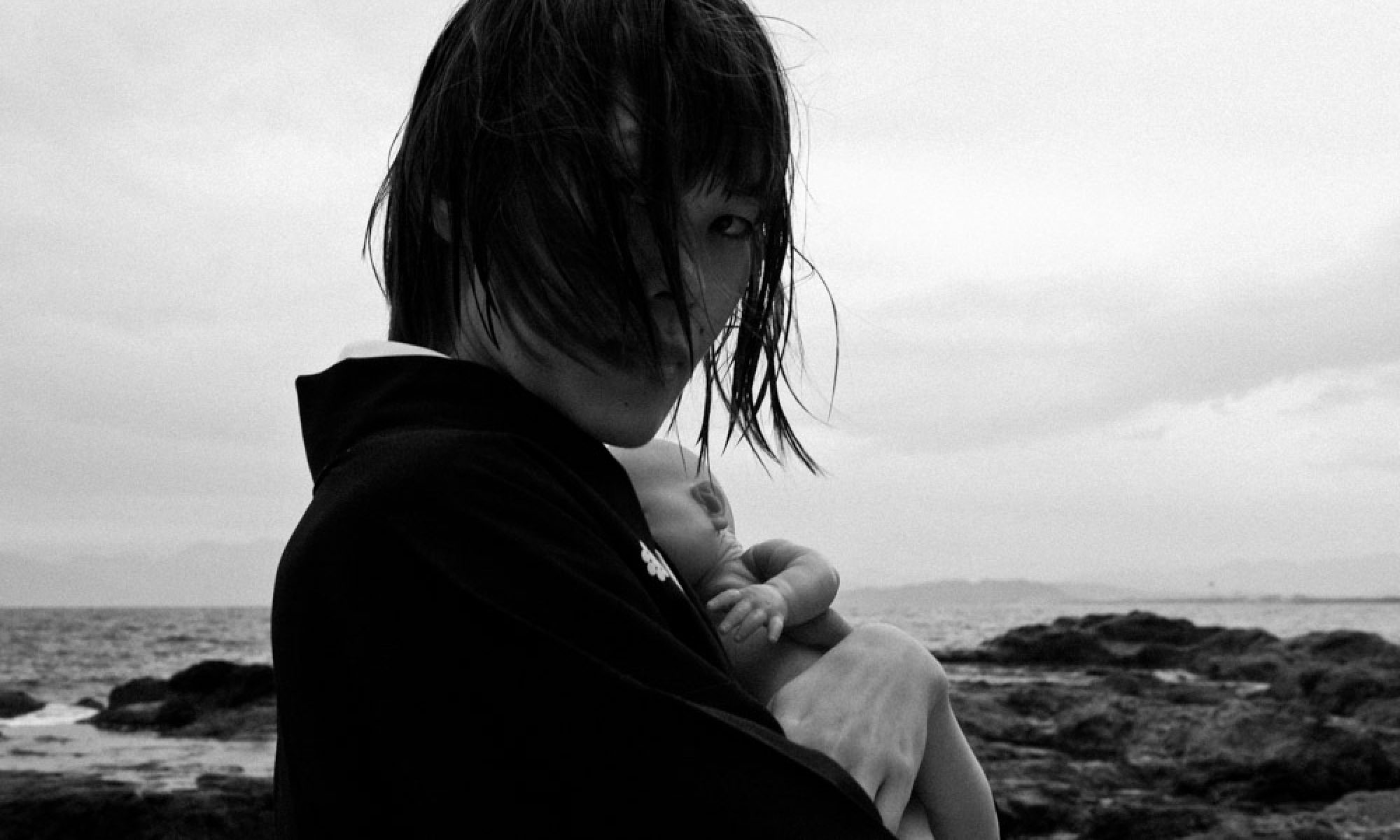
For last, I’d like to mention the woman in school girl uniform holding her newborn baby. There is something so direct and honest about this photo. It must be her eyes..

In Kawori’s own words, “Of all the emotions people have, I feel that ‘anger’ manifests the will to live most”. Her photos indeed express this, but do so in such a beautiful way. Quoting her from the book, “The photos with slit wrists and the like are graphic, but I want to capture the face more than the injury.”

It would be easy to make sensational book with subject matter like this, and do it for the wrong reasons. But she chose to focus in the whole personalities and lives of her subjects, and therefore reveal much more than what’s on the skin, or obviously visible.

Women in the photos are hauntingly beautiful. Every one of them.

Indeed, the very intention of the photographer is totally transparent in this book, even though the photos leave so much for the audience to imagine. Did the woman choose to wear her underwear on her head or was it an idea of the photographer? I don’t know and I don’t care, because her eyes tell the truth.

Only exceptionally talented photographer can achieve something like this. I am really anticipating next work of Kawori Inbe. She is clearly one of the rising stars in Japanese photography scene.

Kawori Inbe is a Tokyo born photographer, and she has received the Annual Miki Jun Award, and held numerous exhibitions in Los Angeles, Barcelona, Hong Kong and Milan. Check out her official site: http://www.inbekawori.com

Like I watch photos and you

I want to be pushed off the cliff. I want to be destroyed. I want to be burned, crashed, chopped to pieces. I want my rotting body to be fed to vultures. Yes, I want art to make me feel something. I want neurons in my brain to light up. I want fucking voltage!

Araki’s photos are like a woman too beautiful. Like a landscape too distant, like vanishing note of last song you hear, you know, like sigh of a lover just before she reaches orgasm. Photos of Araki reach deep down in you and bring back emotions you had long forgotten. Warm, wet and real.

When I first saw Sentimental Journey in Kiasma, I was almost literally in shock for two weeks. I remember I cried sometimes before sleeping, when I imagined the scenery Araki must have felt in his heart when he saw his cat playing in the snow after Yoko’s death. Such beauty was too much for 20 years old virgin like me. And now I know I’ll never recover.

I feel photo criticism is such a vanity for the most part. Waste of time, almost. It would feel so inappropriate to describe photos by easy words, like in Flickr. It’s like describing Henri’s famous photos in Seville “hey Henri, cool compo”. Moriyama Daido can’t use a complicated camera, but prefers to use automatic point and shoot. Going through his photos and saying “look, the guy knows how to use rule of thirds” would feel so silly, wouldn’t it?

Instead I think it makes sense to describe personal encounter with photographic images since it’s a good context to describe yourself and the moment. Photos shouldn’t have titles because titles make viewer see just that one thing in the photo. Unless, of course that’s what the artist wants. I am more interested about the real person than the photos, maybe.

As Susan Sontag said in her book, camera cannot assasinate. But camera can kind of rape, because it can portray person in a way that cannot be controlled by the subject. Photo can show person in a way he or she don’t want to see him or herself. This is the reason women often dislike their photos picked and selected by photographers, but would rather like to pick the shots they like themselves. It is almost impossible that woman would agree with photographer’s vision of herself. Only models can explore the area away from their comfort-zone, but then that’s kind of their job. Most women want to look beautiful. And honestly, I have no idea what that would mean.

Of course, another factor worth considering is time. I don’t just mean about light and shadow, but I mean the spiritual mood of the subject and photographer. Sometimes there is just right time to take photo of a person, often when he or she is not looking to the camera. To understand and cope with this reality is basically life and death for photographer. Great photographers are kind of invisible, they are just there and people don’t care about them.

I would like to also mention in this context what I feel about posed shots (studio shoots / outdoor shoots with model). I don’t think one should be in possession of a fancy camera to make these kinds of photos. In fact, it is interesting to approach posed shoot with a point and shoot camera in natural light setting. Photos like these must also be natural, while still being obviously planned photos. It’s one of my goals to find the climax point between planning and improvisation. I’m really not such a great planner, as those who have worked with me, painfully know. Definably I want to explore the area of posed photography from now.

This is one of “kakkoii hanashi” ( cool talk) and I’m sorry about that, but I think I’m honest when I say that photography is kind of like sex to me. I want to shoot to know I’m not alone.

With love,
Jaakko

Pain of Photography

I find Susan Sontag’s words healing in some strange way, in this chapter she writes about photos of Arbus,

“According to Reich, the masochist’s taste for pain does not spring from a love of pain but from the hope of procuring, by means of pain, a strong sensation; those handicapped by emotional or sensory analgesia only prefer pain to not feeling anything at all.”

It could be argued that photographers seek connection to the world through their photos, great photographers often have had some traumatic event in some point of their lives, after which they find it difficult to connect to the world same way as other people can normally. Ordinary days feel so alien to us..

Photographs may become a way for people to feel something, but it’s at the same time, looking photographs also anesthetize.

Photography can be a way of ultimate cure, entire lifestyle which is built on supporting and protecting the artist’s soul. And at the same time, moments recorded on photographic paper turn into dust, photos themselves fade and disappear, and people forget them. Life is fragile like a piece of paper, other side being death, it takes a faint breeze of dust to flip it around, unexposed image becomes exposed.

Yet, recorded evidence of life makes somehow everything seem less painful, even though actually it might worsen the pain itself in form of nostalgia.

NYIP Feedback

I am really glad to receive the feedback, particularly on this outdoor shade photo. It seems this portrait of beautiful Kayo made impact for the NYIP instructor. The instructor quoted Pulizer winning photographer,

“When you are taking pictures,  you just don’t want to take pictures what show the situation, you want to take pictures which show how it feels like to be there”

If I can be successful in showing audience the mood of the situation or my connection to the subject, then, taking photographs is the thing I want to do.

Regarding Araki's Photos

“Upon closer scrutiny, his subjects are always alone, finding contact difficult, as if preoccupied by a sense of absurdity, a sense that communication between human beings trapped in solitude is impossible.”

Germano Celant’s description of Araki’s photos is remarkably deep and true. This is the very reason why I like Araki; it’s the very loneliness that’s realised in often erotic subject matter. His subjects never look satisfied, but rather isolated and needy; the women look almost like as if they are orphans missing their long lost family members. Solitude fascinates me; that’s why I love Araki.

Sentimental Journey is undoubtedly one of his most personal and most powerful words. The universal message of extreme solitude and loneliness goes across the language and any cultural barrier. I was almost literally in shock for a period of time after seeing the photo series; it was just so powerful message.

Although Araki can be considered very Japanese photographer, he is at the same time very international, because art itself knows no borders. It could very well be that Araki is and will be my favourite photographer.

Business Card

Past years I have had a series of business cards, all featuring my “birdie” logo. The previous versions of my business card have titled me as “visualist”, a general word that refers to my visual work in broader sense, mostly of course web design, 3D graphics and such. It could be even said that “visualist” do video, which I have done, although not quite enough.

However, since I have ran out of my business cards, it’s time to make a new one. I thought I will just go ahead and write “photographer” in it. Honestly, I am somehow a bit ashamed to call myself as photographer since I still feel I’m a total beginner. Even in formal sense, I’m just a photography student at the moment.

But it wouldn’t make much sense to write “student of photography” to the business card, now wouldn’t there?

I solve this dilemma by admitting that I will never be quite finished with my studies, any real photographer would say so about their own career as well; it’s a journey. So I hope you’ll forgive me.

Nakashima Hiroki: Land of Smiles

Yesterday I went to see Nakashima Hiroki’s photo exhibition Land of Smiles in Gallery NIW in Tokyo. I met the photographer in Dark Room Intl. in Yokohama before and had chance to see his work.

Land of Smiles is a collection of candid street portraits took in Thailand.

The portraits show natural connection between the photographer and the subject, and that, according to Nakashima is his purpose. The people looked at ease in their natural poses; the photos didn’t seem to be taken by a traveler, but someone local. Not a small achievement.

The sequencing of the photos as well as the technical quality of the photos were excellent, and show the obvious experience and skill of the photographer. I would also imagine Nakashima’s choice of the media, film instead of digital, is very conscious one.

Overall, the portraits had great variety and all of them had something special. In all of the photos the subjects seemed relaxed and at ease.

After I returned, it occurred to me that perhaps it was the last photo that gave me the final impact, the beautiful young woman dressed in white. The photo had a hint of sadness in it, what I especially liked, a photo that stood out from the others.

Without it, the smiles in the rest of photos might have lost their purpose. The sequencing is very important in any exhibition and the way how Nakashima organized his photos really made them shine, a skill what is only learned by doing.

Land of Smiles is a wonderful work of a human subject.

Visit Gallery NIW until 6/19.