Updated June 11, 2015
Introduction
I have been using Fujifilm X100 now for more than three weeks three years. The first copy of the camera I got had the infamous stuck aperture issue, but I got a replacement one from the retailer. The “stuck aperture” issue seems to be very common with X100 cameras as noted by several blogs. It seems there is some design flaw in the aperture mechanism that plagues the original X100 series. So if you are buying this camera second hand I recommend to check that aperture is closing properly at F16, so that if there’s issue, you can get replacement one, rather than having to wait the repair.
I have always liked shooting in rangefinder style, adjusting the dials while I hold the camera to my eye. The 35mm (equiv.) focal length and large APS-C sensor were strong selling points for me as well. I have never really needed zoom so I don’t care the lack of it. I rather choose the optimized optical quality of the lens.
I also like the Fujifilm’s brave decision to make camera like this. Some of my photographer friends told me “Why don’t you just buy Sony NEX like everyone else and get on with your life?”. I guess it’s spiritual thing. It’s a strange camera, in a good way.
Operation and Handling
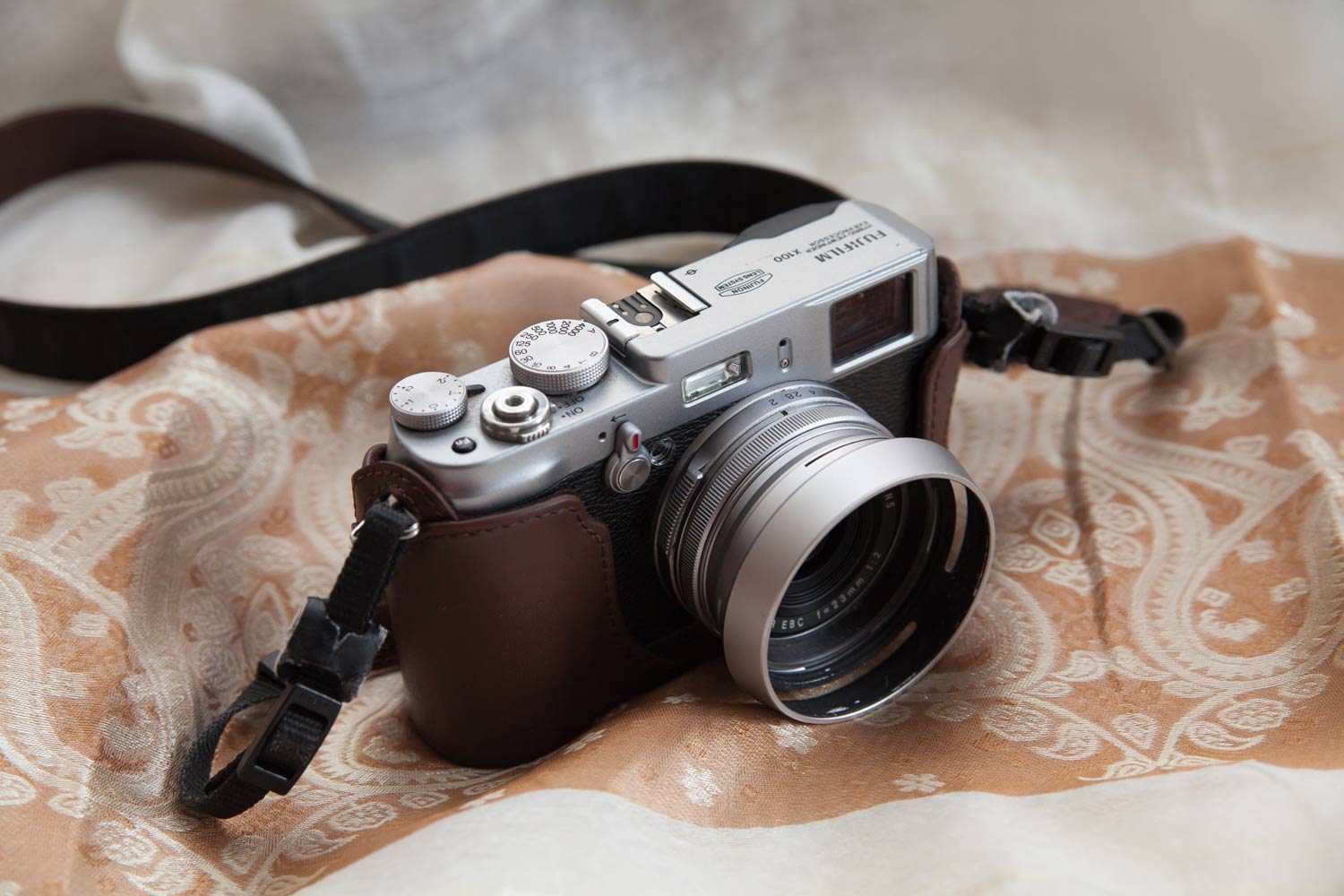
The camera has three main control dials, aperture control ring around the lens (with tabs), shutter speed dial and exposure compensation dial. All of them are milled from solid metal. X100 feels very balanced and easy to hold. The black thing around the magnesium alloy body doesn’t seem to be made of leather, although the camera manual claims it to be, but it provides good enough grip for one handed shooting. I can’t imagine a camera body more solid than this, except maybe Leica. The fit and finish is very good. The numbers on dials are engraved into metal and so is the Fujifilm logo on the top plate.
There’s “focus-by-wire” manual focus ring in the lens, but it takes too many turns to change the focus and there’s pretty bad lag. (1) I tried it couple of times before accepting the fact that this is “autofocus camera”. While it might be possible to shoot full manual with this camera, the MF lag is a painful reality.
Autofocus is pretty fast and accurate. It is based on contrast detection so it won’t compete with DSLRS (with phase detection) in terms of speed, but it it is accurate. The camera has also bright as hell “hey look I’m shooting you” AF assist lamp, which can be turned off in the menu. (2)
Great thing about X100 is that you can shoot even if AF is not achieved.
When in manual focus mode there is also a depth-of-field indicator, which shows the depth of field in distance scale as a white bar visually, which is a very handy feature. Many photographers decide to use the manual mode and press the AFL button to autofocus, and then fine tune the focus by the ring. What’s good about this is that when pressing the jog dial on top of the camera, you get 100% crop on EVF in the viewfinder momentarily which allows you to check focus. Press it again and you’re back in the OVF. Cool.
Metering has three modes, multi, spot and average. Average metering mode is especially suitable when using OVF. It tries to balance the image so that nothing gets overexposed. When you want to really compose the lighting, switch to multi or spot. I keep mine in the spot mode and never even touch others.
I find the camera’s metering to be simply great.
Shooting with this camera feels intuitive, most due to the hybrid viewfinder, which turns on automatically when you bring the camera to your eye. X100’s real trick is that it can overlay the shooting information to the optical viewfinder. So you get best of the both worlds, optical real world image, plus all necessary information with live histogram if necessary. Frame lines and AF are parallax corrected.
Flicking the switch on front of the camera, you can change between EVF / OVF. When shooting macro the camera defaults automatically to EVF, which makes sense due to parallax. Although I’m not big fan of the “TV inside your camera feel” of the EVF, it gives you 100% coverage, so in some occasions it might be great. (For example when shooting in dark and the bright LCD might disturb someone)
On the downside, the default setting of the camera will turn the OVF into EVF for a moment after each shot, showing the preview image in the viewfinder. The preview image can be turned off altogether, eliminating the nuisance, but then the camera won’t show the preview image on LCD either after each shot. Many find this annoying.
As it’s widely reported in web reviews, menu layout and the command dial on the back feel less intuitive. The light plastic command dial is flimsy, although the buttons are not bad. If you take the mindset of trying to avoid using the menus altogether, you certainly can. The FN switch in the top can be customized for quick access of many of the features, although I think most people leave it to default, which is ISO setting. But simple thing as engaging ND filter does require you to dive in the menus, so indeed, it’s a bit annoying that I have to browse every time I need to access such feature. It’s strange that Fujifilm has placed things such as operation sound effects in higher priority than Auto ISO control etc.
But after you memorize the menu items, you can certainly workaround the poor UI. It didn’t ruin the experience for me, and under normal conditions I don
The in-camera flash is surprisingly good. It is clearly adjusted and designed to function as a fill in flash. Although it shoots right to the face, actually this is one of the best in camera flashes I’ve seen. It is meant to provide a slight extra punch to the image just when needed, but remember to unscrew the lens hood if using it.
In X100 there is no dial with “typical A, P, SCENE” etc. If you want aperture priority mode, turn the shutter speed dial to A, and choose aperture by the aperture ring, and you’ve got aperture priority. And vice versa for shutter priority. I find this delightful. But this is also the reason why I wouldn’t recommend this camera for a beginner since there are no modes such as “creative auto”, etc.
Image quality
This camera produces very high quality photos, just as reported in web reviews. I find this camera to produce sharper images than EOS 50D coupled with mid-range Tamron lens. I love how Fujifilm decided to keep the sensor at 12 megapixels instead of trying to compete with the cameras that offer larger megapixel count. Therefore the ISO performance is really good, perhaps one of the best in the market in APS-C sensor cameras. ISO 1600 is totally usable and if you like to shoot black insects in coal mines, you can punch it at least up to 6400 and still getting pretty usable images. The noise reduction is also pretty good and doesn’t result in bad artifacts.
X100 can process RAWs inside the camera. DPreview mentioned that the in-camera processing is even better than the result got with the included software and I second that, since it’s in-camera you can do it without computer. This camera has in fact best in-camera processing I have ever seen. (3)
The film simulation can mimic Fujifilm’s Provia and Velvia films, and this feature is more than a trick or “art filter” ; it really makes practical sense and is slight enough not to be intrusive. The image quality is great when using the any of the film simulation modes, so all is well there.
Other Shooting Modes
There isn’t much to say here. There’s bracketing modes including film simulation and ISO bracketing, “motion panorama” , which produces OK panoramas and artifacts if there are much movement in the scene, and 720p 24fps movie mode which is OK, but suffers from the lack of image stabilization.
Continuous shooting is possible at 5fps (up to 10 jpgs and 8 raw’s) or 3fps. Writing of the images to the SD card will take some time.
Accessories
Expect to pay 3000 yen + if you intend to attach any filter to this camera. Filter adapter ring or lens hood are not included with the camera and must be bought separately.
The lens hood kit includes filter adapter ring but it costs whopping 10,000 yen. The lens hood and adapter are made of aluminum and are very high quality, just like the lens cap. By the way, neither the lens cap or leather case cover will fit over the filter adapter or hood.
The leather case is classy but costs 10.000 yen. Because of the fitting issue I ended up using only the bottom half of it for better grip and some extra protection.
I also bought the smaller version of the external flash, EF-20. It’s very compact and tilts upwards 90 degrees. The bigger brother also swivels and provide more power. EF-20 is very useful when bounced from the ceiling.
The battery charger is a bit weird with loose plastic piece that’s required to charge the battery. It seems very odd move from Fujifilm. Also the symmetrical shape battery can be placed in the camera and charger in four different ways (and only one being the correct, of course) so it takes some practice. The battery NP-95 offers reasonably good amount of shots but recharging is rather slow. Getting a spare is a good idea.
The included mini USB cable is NOT a standard mini USB cable, but unique Fujifilm cable, so don’t lose it!
The camera also supports good old mechanical shutter release. (4)
The camera manual is written in batshitcrazy-lawyer-english. Although it explains the operation of the camera it doesn’t really provide much useful tips for actual shooting.
Final Word
There’s something almost spiritual when shooting with X100. It just feels right. It’s possible to operate the most important settings while holding the camera up to your eye and there’s a lot of this analog “tactile feel” to the camera’s dials. It’s almost shocking to use DSLR after a shooting session with X100. The experience is that good.
It would be wrong to compare this camera to Leica M9, since the camera is totally different and also in different price range. But those who long for the good old range finder days might find some salvation in this cool retro camera. And X100 pleases the eye. (5)
I recommend this camera for any advanced amateur/prosumer / photography enthusiast. It’s more expensive than other cameras with APS-C sensor but it offers luxury of great hybrid viewfinder, high quality lens, beautiful design and a nearly silent shutter.
This is not a compact camera but a serious tool for artist who wants manual control over his image, but also portability and small form factor.
[vc_separator type=’normal’ position=’center’ color=” border_style=” thickness=” up=” down=”]
Notes:
- With the latest firmware update the manual focus works much better. It might not be the best feature but it definitely works, especially with the focus peaking which was introduced by this update.
- The firmware update also improved autofocus accuracy and speed somewhat.
- I nowadays only shoot RAW with X100. Lightroom can process these raws very nicely a quality that’s very very good.
- So many people made comments about my camera’s looks, asking “is it a film camera”. They still do, even though the retro style is pretty popular nowadays with compact cameras. It’s a pretty nice looking thing.