Pre-Raphaelites

I found my new treasure last week. A book about Pre-Raphaelites, Masterpieces of Art by Gordon Kerr.

The paintings depict religious figures as normal people, then aspects of the society of the era and love and female beauty.

The strong emotional concepts of the paintings are so natural but never overstated. There was a painting of a sailor boy who learned about the passing of his mother after his return from the sea. The boy’s face is partially buried on the green grass, his cheeks red. His emotion is not shown directly, but by the face of a female figure next to him. It’s natural and beautiful.

The book makes me feel the strong empathy by the artists to the ordinary human suffering. The paintings never ridicule but wrap their subjects in a gentle fabric of artistic expression. Jesus stretching his arms in leisurely, his shadow accidentally being cast on a wood beam resembling his crucifixion, his mother shocked by the realization. His face is carefree and gay, maybe even stupidly so, yet this must be how the person lived in the real world.

The pictures surprise and I love to be surprised by art. “Art is love”, the book states. Maybe art is kind of celebration of human, the love expressed by the passion and sometimes chosen suffering of the artist, to express a higher truth about our existence.

For me art offers a kind of safe room to think about my life and past.

I wish we could live our lives more spiritually, celebrating our desire and existence.

Time to go back.. to the moon.. Review

This book is like a huge shock! Not because of the subject matter, but because of the honest way how these photos are taken. It is my first time to meet Kawori Inbe via her photographs, but by reading this book I was able to form a a clear image of her in my mind.

“Time to go back.. to the moon”, is like art in a way it’s put together, but the stories presented are real, as what also the text confirms. Inbe achieved to capture the subject’s anger, loneliness and sorrow in a way which is unlike anything I’ve ever seen. The book is a fascinating wonderland of experimental posed photography, but bruises and slit wrists are real. I think the photos could be considered kind of documentary and I don’t really feel that the women are posed.

There are four photographs that struck my heart especially. One would be the first photo of the book, where the young woman with stitched arm is holding what appears to be two razor blades. She has a headlight on her head and she is standing outside in dark alley. She is wearing white gown, and her expression is haunting.

Another photo would be bruised woman against white backdrop. Her eyes are devoid of life, and speak her whole story.

Then there is photo of two women holding each other in what appears to be a street of Tokyo, one wearing blue dress and one wearing red. Woman in red seems lonely or afraid, and the woman in blue is comforting her. Perhaps the women are warming each other in the cold wind of the cruel city society.

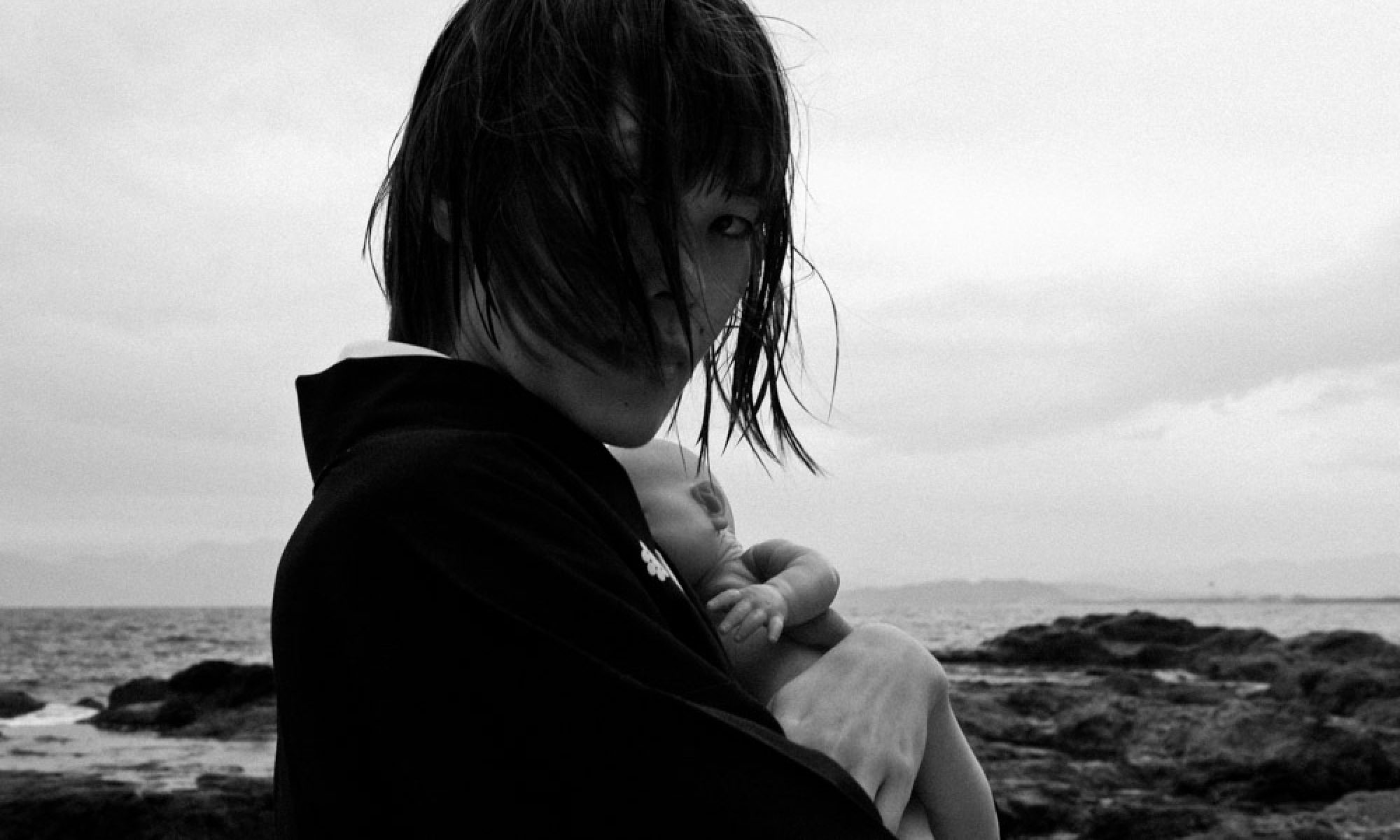
For last, I’d like to mention the woman in school girl uniform holding her newborn baby. There is something so direct and honest about this photo. It must be her eyes..

In Kawori’s own words, “Of all the emotions people have, I feel that ‘anger’ manifests the will to live most”. Her photos indeed express this, but do so in such a beautiful way. Quoting her from the book, “The photos with slit wrists and the like are graphic, but I want to capture the face more than the injury.”

It would be easy to make sensational book with subject matter like this, and do it for the wrong reasons. But she chose to focus in the whole personalities and lives of her subjects, and therefore reveal much more than what’s on the skin, or obviously visible.

Women in the photos are hauntingly beautiful. Every one of them.

Indeed, the very intention of the photographer is totally transparent in this book, even though the photos leave so much for the audience to imagine. Did the woman choose to wear her underwear on her head or was it an idea of the photographer? I don’t know and I don’t care, because her eyes tell the truth.

Only exceptionally talented photographer can achieve something like this. I am really anticipating next work of Kawori Inbe. She is clearly one of the rising stars in Japanese photography scene.

Kawori Inbe is a Tokyo born photographer, and she has received the Annual Miki Jun Award, and held numerous exhibitions in Los Angeles, Barcelona, Hong Kong and Milan. Check out her official site: http://www.inbekawori.com
Gods of Earth and Heaven

Joel-Peter Witkin’s Gods of Earth and Heaven sent chills through my spine. Amazing, really honest piece of surreal photography that is also universal.

This appropriately named book might be shocking for some but for me I didn’t feel shock, just surprise. There’s nothing vulgar about it and nothing scandalous, but it’s more like surreal composition or strange documentary of humanity. The pictures really had smell to them, and then the bible-like cross on the cover is just wicked!

I was deeply surprised and impressed, not many photographs can do that to me nowadays. I must buy this book to study it further.

Araki (Portfolio)

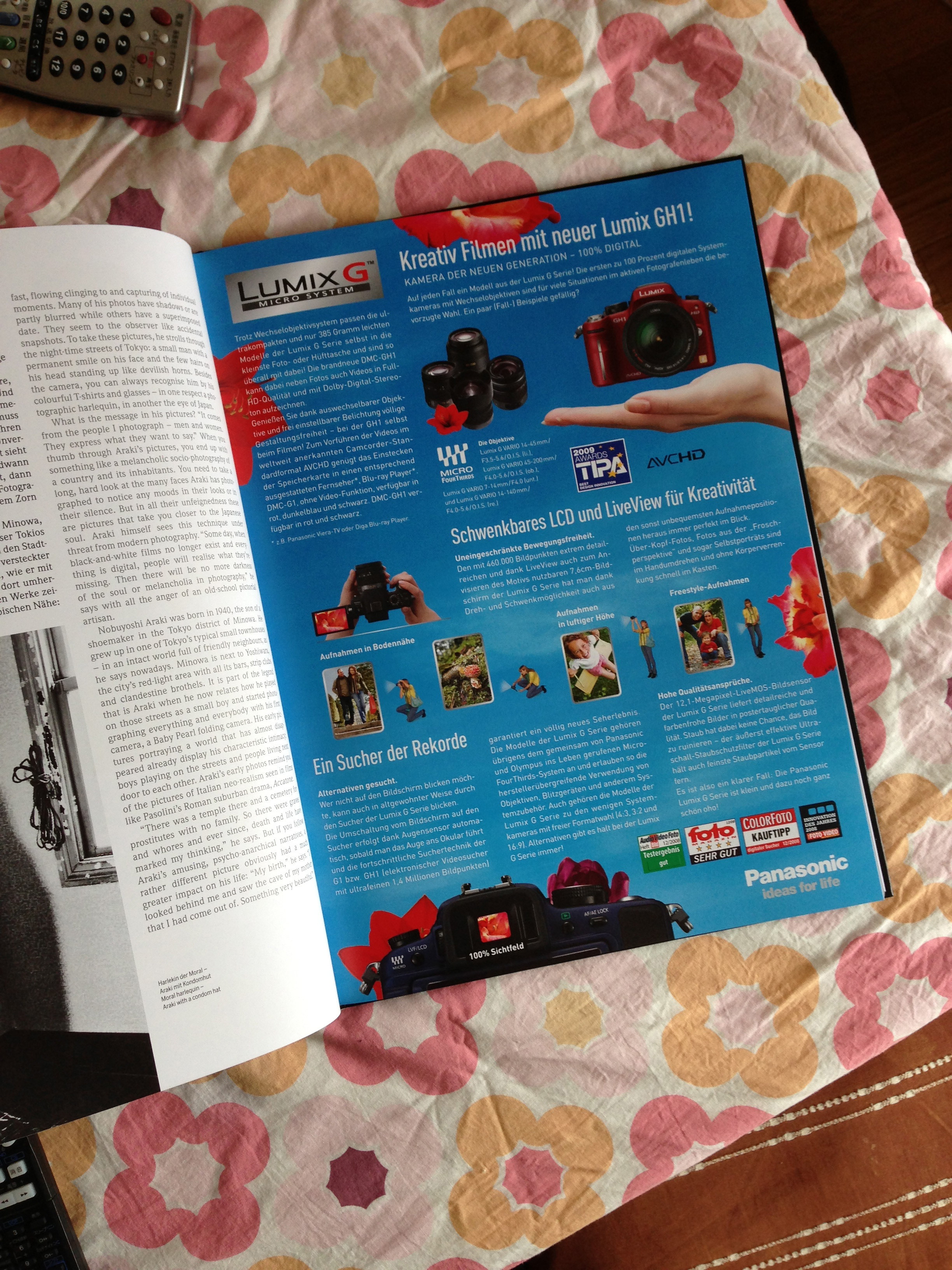
I had my recent WTF moment when I opened “Araki (Portfolio)” which I bought from Amazon. The book has awful Tamron and Sigma ads which feels like someone pouring cold water on you while you are having sex. Ads just don’t belong to art book! You can’t even rip the ads off the book since they are integrated into the pages.

Anyway, the sentence first page by the Stern-Art-Director Donald Schneider kinda made me sad: “It wasn’t that I hadn’t seen any sex, porn or SM photos before…”. It’s obvious that the director himself does not understand the deeper meaning or context of Araki’s work. I don’t know how Araki’s photos are perceived in Germany, it might be something cultural, but they sure didn’t receive this bad treatment in Kiasma in Helsinki!

The other introduction by Jochen Siemens is kinda okay, nice little text to accompany Araki’s photos. There is also a short interview with Araki which is kinda nice.

I regret however buying this book since there are tons of much better publications which portray Araki’s work in more spiritual and sensitive way. I definably recommend to skip this book unless you love ads featuring years old camera equipment.


Magnum Contact Sheets

I recently bought the latest edition of Magnum Contact Sheets (2011, Edited by Kristen Lubben). This (huge!) book is a landmark, perhaps one of the most important photography publications out there.

Contact sheet used to be a common tool for photographers when reviewing their work; it allowed photographers to see a quick overview of the images they had shot. This first draft reveals the thought process and work method of the photographer since the original sequence of the exposed film is preserved.

Indeed, contact print is something intimate that photographers are not usually willing to show. Quoting Henri Cartier-Bresson (from page 18), “A contact sheet is full of erasures, full of detritus”, and that “A photo exhibition or a book is an invitation to a meal, and it’s not customary to make guests poke their noses into the pots and pans, and even less into the buckets or peelings..”.

I wasn’t particularly interested in seeing the mistakes of other photographers, but more I wanted to see the flow of images that existed in original film, I find there is something very beautiful and human in the process and how the mind of the photographer works. A perfect marriage of the analog workflow and human subject..

The book starts with iconic images of Cartier-Bresson in Seville in 1933, and chronologically walks the reader through the century of great photographic culture into the present day. The written stories and descriptions by the photographers themselves are fascinating to read; here are many amazing, moving stories here. I am especially touched about description of Marilyn Silverstone’s life, she was the only woman photographer to record Dalai Lama’s arrival to India in 1959 and became Tibetan Buddhist nun in the later years.

And then there is the iconic picture of the lone protestor in Tiananmen Square.

But Magnum Contact Sheets is not only a record of famous images with historical importance, it’s a record of the art itself. On the latter pages there are even video stills, and screen shots of the thumbnail images on computer screen.

It will be interesting to see how this book will develop in future as more and more photographers switch to digital.

I really recommend this book to anyone interested in photography or the human subject.

Misao the Big Mama and Fukumaru the Cat

Yesterday, I found Miyoko Ihara’s photo book “Misao the Big Mama and Fukumaru the Cat”. The photos are unique and heartwarming; I can feel the photographer’s intention clearly; the human connection between the cat and grandma.

In her website she says:

“My grandmother and her cat are always together. This is the photobook captured the everyday life of my grandmother, Misa who bends her self to the fields work with her cat Fukumaru.”

What especially delighted me about this book is what I call a kind of artistic honesty; Ihara doesn’t try to be artistic, the photos are simple captures of real life events, but are exactly that in creative and artistic way. Ihara’s framing and selection of subject feels very profound and honest; it must be the result of her years in Nippon Photography Institute that took her to this level.

Although I understand why some of the photos might be criticized as being a kind of cute, the meaning behind the photos is clear; they are honest description of human connection. Fukumaru is very unique, odd-eyed cat and his partner and the 87 years old grandmother whose eyes show experience of life are naturally suited to each other.

The life of this couple is well captured in their green, lush environment.

It’s remarkable what the photos show if you take a moment to really look at them. Sure they are cute photos, but they are also much more. It is unclear to me at this point whether the photos were taken digitally or with film camera, but in any case, the print is excellent with very rich and saturated colors.

Especially I was moved about the second last photo, a rainbow captured in a very beautiful way.

I highly recommend this photo book to anyone interested in photography.

Find out more about the photo book in:
http://www.littlemore.co.jp/enstore/products/detail.php?product_id=357