Gallery is now updated with my Jeju photos. This is kind of fresh look to the material I shot in Jeju in summer 2012. There are some digital shots as well as 35mm film.
Time to go back.. to the moon.. Review
This book is like a huge shock! Not because of the subject matter, but because of the honest way how these photos are taken. It is my first time to meet Kawori Inbe via her photographs, but by reading this book I was able to form a a clear image of her in my mind.
“Time to go back.. to the moon”, is like art in a way it’s put together, but the stories presented are real, as what also the text confirms. Inbe achieved to capture the subject’s anger, loneliness and sorrow in a way which is unlike anything I’ve ever seen. The book is a fascinating wonderland of experimental posed photography, but bruises and slit wrists are real. I think the photos could be considered kind of documentary and I don’t really feel that the women are posed.
There are four photographs that struck my heart especially. One would be the first photo of the book, where the young woman with stitched arm is holding what appears to be two razor blades. She has a headlight on her head and she is standing outside in dark alley. She is wearing white gown, and her expression is haunting.
Another photo would be bruised woman against white backdrop. Her eyes are devoid of life, and speak her whole story.
Then there is photo of two women holding each other in what appears to be a street of Tokyo, one wearing blue dress and one wearing red. Woman in red seems lonely or afraid, and the woman in blue is comforting her. Perhaps the women are warming each other in the cold wind of the cruel city society.
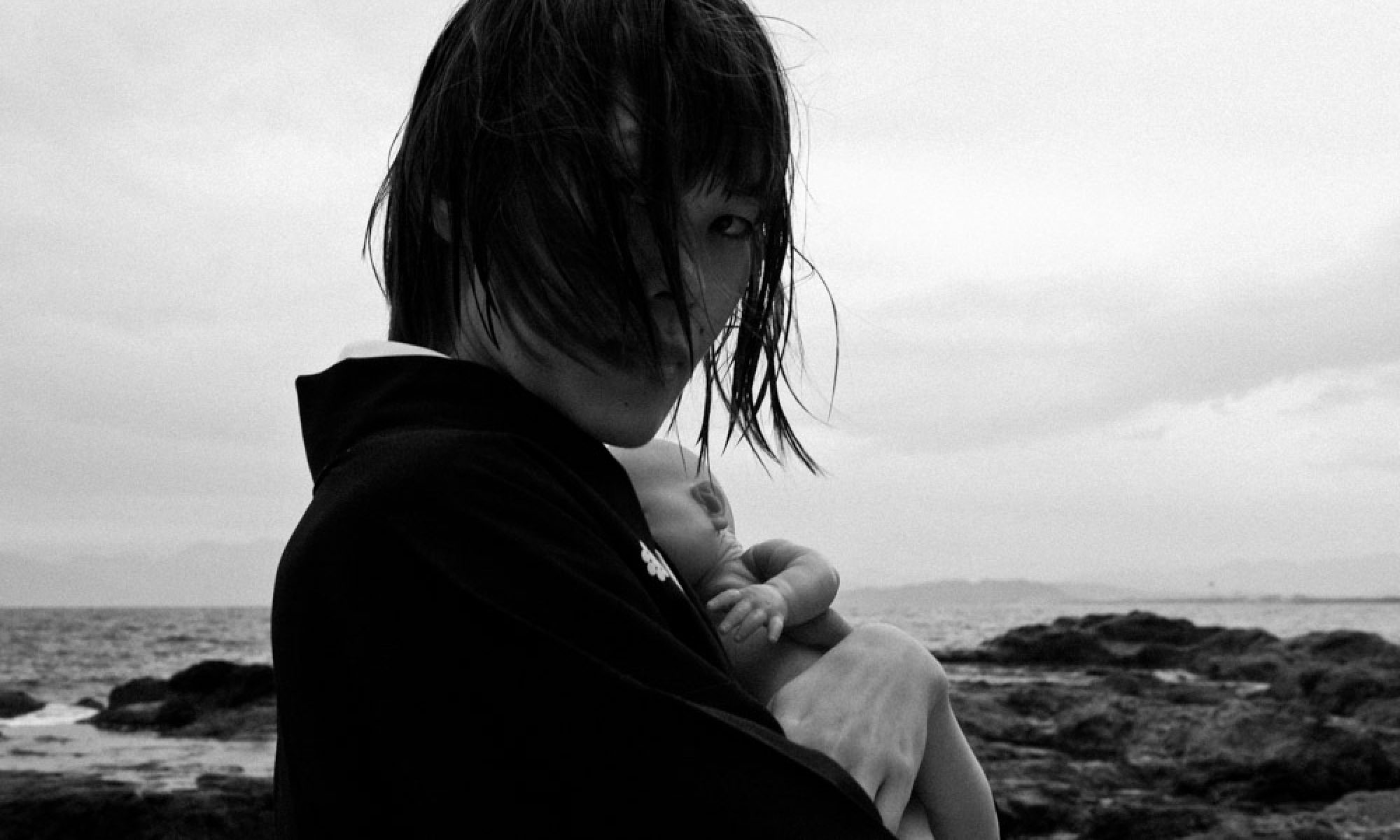
For last, I’d like to mention the woman in school girl uniform holding her newborn baby. There is something so direct and honest about this photo. It must be her eyes..
In Kawori’s own words, “Of all the emotions people have, I feel that ‘anger’ manifests the will to live most”. Her photos indeed express this, but do so in such a beautiful way. Quoting her from the book, “The photos with slit wrists and the like are graphic, but I want to capture the face more than the injury.”
It would be easy to make sensational book with subject matter like this, and do it for the wrong reasons. But she chose to focus in the whole personalities and lives of her subjects, and therefore reveal much more than what’s on the skin, or obviously visible.
Women in the photos are hauntingly beautiful. Every one of them.
Indeed, the very intention of the photographer is totally transparent in this book, even though the photos leave so much for the audience to imagine. Did the woman choose to wear her underwear on her head or was it an idea of the photographer? I don’t know and I don’t care, because her eyes tell the truth.
Only exceptionally talented photographer can achieve something like this. I am really anticipating next work of Kawori Inbe. She is clearly one of the rising stars in Japanese photography scene.
Kawori Inbe is a Tokyo born photographer, and she has received the Annual Miki Jun Award, and held numerous exhibitions in Los Angeles, Barcelona, Hong Kong and Milan. Check out her official site: http://www.inbekawori.com
Gods of Earth and Heaven
Joel-Peter Witkin’s Gods of Earth and Heaven sent chills through my spine. Amazing, really honest piece of surreal photography that is also universal.
This appropriately named book might be shocking for some but for me I didn’t feel shock, just surprise. There’s nothing vulgar about it and nothing scandalous, but it’s more like surreal composition or strange documentary of humanity. The pictures really had smell to them, and then the bible-like cross on the cover is just wicked!
I was deeply surprised and impressed, not many photographs can do that to me nowadays. I must buy this book to study it further.
From Baghdad
Servants begin to gather around. They are efficient and quick and all of them wear
their blond hair tied up, knotted. Then it strikes me that all of them wear nothing but
aprons. ”Wow… Quite a guy.” I think again.
Baghdad 2006, by Jaakko Saari
Magnum Contact Sheets
I recently bought the latest edition of Magnum Contact Sheets (2011, Edited by Kristen Lubben). This (huge!) book is a landmark, perhaps one of the most important photography publications out there.
Contact sheet used to be a common tool for photographers when reviewing their work; it allowed photographers to see a quick overview of the images they had shot. This first draft reveals the thought process and work method of the photographer since the original sequence of the exposed film is preserved.
Indeed, contact print is something intimate that photographers are not usually willing to show. Quoting Henri Cartier-Bresson (from page 18), “A contact sheet is full of erasures, full of detritus”, and that “A photo exhibition or a book is an invitation to a meal, and it’s not customary to make guests poke their noses into the pots and pans, and even less into the buckets or peelings..”.
I wasn’t particularly interested in seeing the mistakes of other photographers, but more I wanted to see the flow of images that existed in original film, I find there is something very beautiful and human in the process and how the mind of the photographer works. A perfect marriage of the analog workflow and human subject..
The book starts with iconic images of Cartier-Bresson in Seville in 1933, and chronologically walks the reader through the century of great photographic culture into the present day. The written stories and descriptions by the photographers themselves are fascinating to read; here are many amazing, moving stories here. I am especially touched about description of Marilyn Silverstone’s life, she was the only woman photographer to record Dalai Lama’s arrival to India in 1959 and became Tibetan Buddhist nun in the later years.
And then there is the iconic picture of the lone protestor in Tiananmen Square.
But Magnum Contact Sheets is not only a record of famous images with historical importance, it’s a record of the art itself. On the latter pages there are even video stills, and screen shots of the thumbnail images on computer screen.
It will be interesting to see how this book will develop in future as more and more photographers switch to digital.
I really recommend this book to anyone interested in photography or the human subject.
Police Work
I love Leonard Freed’s comment regarding his contact sheets in Magnum Contact Sheets “Police Work”:
“Contact sheets are mostly a waste of money, I find. 99.9 per cent of the frames on the contact sheet are mistakes one makes while photographing. Because it is a waste of money, I love them. There are things in life we must do just because we find them unprofitable”.
I couldn’t agree more.